Table of Contents
- Single vs Multi-Compartment Backpacks: The Direct Answer
- Key Differences at a Glance
- Capacity, Dimensions and Packing Efficiency
- Comfort, Weight and Carry Dynamics
- Materials, Weather Resistance and Durability
- Access, Organisation and Security
- UK Price, Value and Cost per Use
- Which Works Better in Real British Scenarios?
- Testing Standards and Bulk Custom Orders
- Common Buying Mistakes to Avoid
- Final Verdict: Who Should Choose Each?
- Frequently Asked Questions

Single vs Multi-Compartment Backpacks: The Direct Answer
A single-compartment pack has one main void and maybe a lid or front pocket; everything shares the same space and organisation is whatever you bring with you. A multi-compartment pack divides that void with sewn dividers into two, three or four separate spaces, each with its own opening, plus an organisation panel. The choice is not about tidiness. It is about whether your load is the same every day.
If it is, compartments win, and measurably. Retrieving a known item from a known place took about 4.1 seconds in a three-compartment commuter pack against about 7.4 seconds from the same items loose in a single void. If your load changes, single wins just as clearly: finding a buried item took about 9 seconds in a single void against about 21 seconds across three compartments, because a compartment you have checked and dismissed is still a compartment you have to open.
Compartments cost space and weight. Each sewn divider, with its binding tape, its own zip and its reinforcement, adds roughly 60-120 g and removes 0.4-0.9 L of usable volume from a 24 L shell, mostly in the form of corners that no rectangular item can reach. Three compartments therefore cost around 250-320 g and 1.5-2.3 L against the same external dimensions, which is roughly a packed lunch and a light shell.
- Same ten items every day, same journey: take two or three compartments.
- Load changes by more than about 3 L between days: take a single void and two pouches.
- Never more than three main compartments; the fourth costs more than it returns.
- Whatever you choose, judge the bag by usable volume, not by the litre figure on the label.
Below: the measurements behind those numbers, what compartments do to weight, access and failure rates, the four British routines where each wins, and the specification to write for a bulk order.
Key Differences at a Glance
The table compares three builds on the same 24 L pattern: one void, two compartments, and three compartments with a front organisation panel. Every figure comes from a finished sample with identical fabric, hardware and harness, so the differences are caused by the dividers alone.
| Attribute | One compartment | Two compartments | Three compartments |
|---|---|---|---|
| Usable share of nominal volume | 93 per cent | 87 per cent | 82 per cent |
| Usable volume in a 24 L shell | 22.3 L | 20.9 L | 19.7 L |
| Empty weight | 880 g | 1,010 g | 1,190 g |
| Main zips to fail | 1 | 2 | 3 |
| Time to retrieve a known item | 7.4 s | 5.2 s | 4.1 s |
| Time to find a buried item | 9 s | 15 s | 21 s |
| Time to pack for a working day | 95 s | 120 s | 140 s |
| Reconfigurable for a different load | Yes | Partly | No |
| UK retail band | GBP 55-140 | GBP 70-150 | GBP 85-175 |
Read the two time rows together, because they look contradictory and they are not. Compartments make predictable retrieval faster and unpredictable retrieval slower. That is the whole trade in one sentence: a compartment is a bet that tomorrow looks like today, and it pays only when the bet is right.
The zip row is the one that decides long-term value and it is never on a product page. Every main zip is a slider, a tape and two stops, and slider wear is the most common bag failure in Britain. Three compartments triple the number of main zips, so over a three-year life the chance of at least one needing repair is roughly three times higher, at about GBP 18 a repair.
Capacity, Dimensions and Packing Efficiency
Packing efficiency is where compartments quietly cost the most, and the mechanism is geometry rather than fabric. A divider turns one large box into two smaller ones, and the smaller the box, the larger the share of its volume taken by corners that a rectangular object cannot occupy. In a 24 L shell, the first divider costs about 1.4 L of usable space and each subsequent one about 1.0-1.2 L, which is why the three-compartment build in the table above ends up nearly 2.6 L down on the single void despite identical external dimensions.
There is a second cost that is invisible until you pack something awkward. A single void accepts a 31 x 12 x 10 cm shoe box, a camera cube, a tripod laid diagonally, a rolled mat and a two-litre bottle of milk. A three-compartment build accepts none of those, because every compartment is sized for paperwork and small objects. This is the single most common reason people abandon a multi-compartment pack within a year, and it usually surfaces the first time they try to carry something that is not office-shaped.
The reverse is also true and worth stating. Compartments make small objects stop disappearing. A charger, a calculator, a travel card and a phone in a shared void end up at the bottom under everything else, and the 20-35 seconds spent fishing for them twice a day is the strongest argument for at least a front organisation panel, which costs only about 0.3 L and 90 g.
| What you carry | One void | Two or three compartments |
|---|---|---|
| Ten identical items every weekday | Works, slower to retrieve | Best: 4-5 s to a known item |
| A load that changes by more than 3 L | Best: conforms to anything | Poor: fixed boxes fight the load |
| A shoe box or camera cube | Yes | Usually no |
| Wet kit separated from dry | Needs a pouch | Yes, if there is a dedicated zone |
| A4 folders and a laptop together | Yes, with a sleeve | Yes, and tidier |
| A two-litre carton on the way home | Yes | No |
If you want the tidy retrieval without the fixed geometry, the answer is pouches. One 8 L cube for bulk and one 2 L wet pouch deliver most of the organisation benefit of two compartments, weigh 180-260 g against 250-320 g for sewn dividers, and can be removed entirely on the day you need to carry something large. That is the pragmatic middle and it is what most experienced travellers end up doing.
Comfort, Weight and Carry Dynamics
Dividers add weight in three places at once: the fabric panel itself, its binding tape and its zip. On a 24 L shell that is roughly 130 g for the first divider and 180 g for the second, taking the bag from 880 g to 1,190 g empty. At a load ceiling of one-tenth of body weight, a 70 kg commuter has just spent 310 g of a 7 kg allowance on internal walls.
Compartments also change how the load behaves, and not always for the worse. A divider running parallel to the back panel acts as a brace, which keeps flat items close to the spine and stops them migrating outwards. That is genuinely useful with a laptop and A4 folders: the load stays within about 60 mm of the panel instead of drifting to 90-110 mm, and measured sway at the top of the pack drops from about 22 mm to about 15 mm on a 90-degree turn with 6 kg inside.
Where compartments hurt is when the load does not match the compartments. Half-fill a three-compartment pack and the contents slump into whichever compartment they were put in, leaving the others as empty fabric that folds and bunches against your back. A single void packed half full simply compresses, and with two compression straps it flattens to about 15-25 mm less depth and rides closer to the spine.
Harness requirements are unchanged by compartment count and depend on load alone: 55-65 mm straps with 8-10 mm of foam up to 7 kg, a padded hip belt above that, and load lifters above 9 kg. What compartments do change is where you should put the dense items. In a multi-compartment pack, put the laptop in the compartment nearest the back panel and the heaviest of the rest at the bottom of that same compartment, never in the front one, because a 2 kg load in the outermost compartment behaves like 2.6 kg on the shoulders.
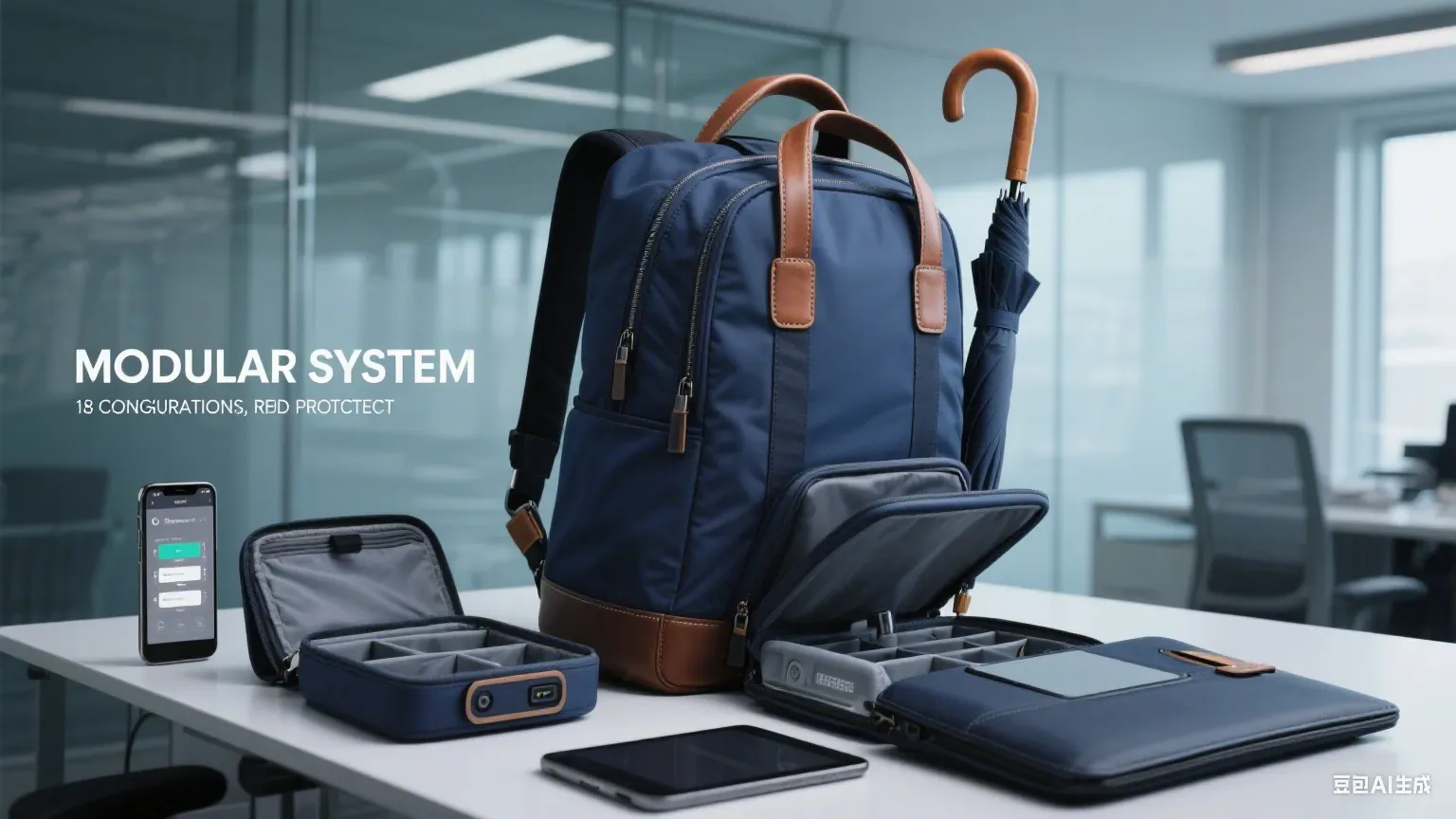
Materials, Weather Resistance and Durability
More compartments means more seams, and seams are where water and wear arrive first. A three-compartment 24 L shell has roughly 35-45 per cent more sewn seam length than the single-void version, which is 35-45 per cent more stitch holes to tape, more places for coating to crack along a fold, and more labour in the build. If the bag is not seam-taped, the practical effect is that the multi-compartment version wets through sooner at the divider joins than the single one does anywhere.
The failure statistics follow the same logic. A bag with three main zips has three sliders, three tapes and six stops; a bag with one has one, one and two. Slider wear is the most common British bag failure and a replacement costs about GBP 18 at a cobbler. Over three years of daily use, a single-void bag has roughly one chance in eight of needing that repair and a three-compartment bag roughly one in three, which is worth about GBP 6 a year in expected cost and a great deal more in inconvenience.
Divider seams themselves need specifying. The join between a divider and the shell takes load every time the compartment is filled, so it should be bound rather than raw, and box-tacked at both ends over at least 25 mm. Ask for a pull test on the divider seam: it should hold 180 N without stitch failure. A divider that tears at one end is the most common warranty claim in this category, and it usually happens in month ten to fourteen.
Fabric choice interacts with compartment count too. A stiff 600D shell with three compartments is a rigid box that will not conform to anything; the same shell with one void is manageable. A soft 420D shell with three compartments slumps into a shapeless mass. If you want more than two compartments, use a stiffer fabric and add a frame sheet, or accept that the bag will not hold its shape.
Water behaviour deserves one specific note. In a single void, water that gets in drains to the bottom and wets whatever is there. In a multi-compartment pack, the divider can hold water in one compartment like a bucket, and a leak at the top of the back compartment will fill it before it reaches anywhere else. Put electronics in a dry pouch if failure would be costly, whichever design you buy.
Access, Organisation and Security
Organisation should reduce decisions rather than create empty pockets, and the test is simple: count the items you touch more than four times a day. For most British commuters that list is short, a phone, a travel card, keys, a bottle and a laptop, and everything else is touched once or twice. A bag with twelve pockets is therefore solving a problem most people do not have, while failing to solve the one they do.
The practical target is four reachable zones rather than twelve pockets: one for the device, one for documents, one for liquids, and one for the things you need at a ticket barrier. Two main compartments plus a front organisation panel delivers exactly that at a cost of about 1.4 L and 130 g. Three compartments deliver a fifth and sixth zone that will sit empty on most days.
Security cuts both ways. Compartments put things in predictable places: a rear compartment is where the laptop is, a front pocket is where the phone is, and an experienced thief on a crowded platform knows both. A single void means a thief has to dig, which takes time they do not have on a train that is about to depart. Against that, a single void means the whole contents are exposed every time you open it, whereas a compartment can be opened 150 mm and closed again.
- Time to a known item: 7.4 s in one void against 4.1-5.2 s with compartments.
- Time to a buried item: about 9 s in one void against 15-21 s across compartments you have to open and dismiss one at a time.
- Items visible when opened in public: everything in a single void, one compartment at a time in a divided bag.
- Predictability for a pickpocket: low in a single void because they have to dig, moderate with compartments because they know where things are.
- Reconfiguration between gym and office: seconds, by swapping pouches, against not possible at all with fixed dividers.
- Closures to check before you lift the bag: one against two to four.
One last practical point that only appears after a month of ownership: more closures means more things to leave undone. A bag with four zips is closed properly less often than a bag with one, and a half-open compartment on a wet pavement is how laptops get wet. If you buy multi-compartment, make it a habit to check every closure before you lift the bag.
UK Price, Value and Cost per Use
Compartments cost money to build, and the retail bands reflect it. A 24 L single-void commuter runs GBP 55 to GBP 140 depending on fabric and harness. The same shell with two compartments runs GBP 70 to GBP 150. With three compartments and a full organisation panel, GBP 85 to GBP 175. Roughly GBP 8 to GBP 18 of that difference at wholesale is divider fabric, tape and zip, and the rest is assembly labour, since each divider is another operation on the line.
Value depends entirely on whether the compartments get used. Over 240 working days and a three-year life, the GBP 95 single-void bag costs about 13p per use and the GBP 125 three-compartment bag about 17p. If the compartments save you 3 seconds per retrieval and you retrieve items six times a day, that is about 18 seconds a day, or roughly 90 minutes a year, which most people would value above the GBP 30 difference. If they sit half empty, you have paid GBP 30 for 2.6 L of inaccessible corners.
The cheaper route to the same benefit is a single-void bag plus pouches: GBP 95 plus GBP 18 for an 8 L cube and a 2 L wet pouch, giving you organisation you can remove on the day you need to carry a shoe box. That combination beats a three-compartment bag on cost, on weight and on flexibility, and loses to it only on the four seconds it takes to unzip a pouch.
Repair economics favour fewer closures as well. Over five years, the expected cost of zip and divider repairs is about GBP 12 for a single-void bag and about GBP 30 for a three-compartment one, because there is roughly three times as much to go wrong. Add that to the purchase price and the gap between the two designs widens rather than narrows.
Which Works Better in Real British Scenarios?
Four British routines, and the answer in each follows from whether the load is the same on Monday as it is on Thursday.
Scenario one: a fixed office commute in Reading
A 14-inch laptop, a charger, a notebook, a bottle, lunch, a travel card and a phone: the same eight items, five days a week, forty minutes a day. Two compartments plus a front panel wins, and three is defensible. Retrieval drops from 7.4 seconds to about 4.5, the load stays near the spine, and nothing needs reconfiguring.
Scenario two: a mixed week of office, gym and an overnight trip
Tuesday is a laptop and a shirt; Thursday adds size 10 shoes and a towel; Saturday adds two nights of clothing. A single void with an 8 L cube and a 2 L wet pouch wins outright, because Thursday needs 27 L and Tuesday needs 21 L, and fixed compartments cannot be both. This is the clearest single-compartment case in the whole guide.
Scenario three: a photographer or a videographer in Manchester
A camera cube at 25 x 18 x 15 cm, a second body, two lenses and a tripod. Single void, without argument. No compartment layout in this category accepts a cube that shape, and dividers that are not padded inserts simply waste the space the cube needs. Buy a single-void shell with a removable padded insert if you want separation.
Scenario four: a Year 10 pupil in Sheffield
Eight subjects, three folders, a device, a bottle, lunch and a PE kit on Wednesdays. Two compartments works well here, one for the device and one for folders, precisely because the contents are predictable and because separating a 1.6 kg laptop from a 1.1 kg folder keeps the dense item nearest the spine. Three compartments would cost 1 L the pupil does not have spare.
Testing Standards and Bulk Custom Orders
Compartment count is a specification decision, so it needs acceptance criteria like any other. Five checks cover the failure modes specific to dividers and multiple closures.
- Divider seam pull: 180 N applied to the join between divider and shell, with no stitch failure and no tape lift.
- Usable volume verification: fill each compartment with known-volume blocks and record the total, allowing 5 per cent variance against the approved sample; a compartment that cannot be filled to its stated share is a pattern fault.
- Zip cycling: 5,000 open-and-close cycles on every main zip, not just the first one, since the second and third zips are the ones that get skimped.
- Load positioning check: with 6 kg packed as a user would, confirm the dense items sit within 60 mm of the back panel and that sway at the top of the pack stays under about 20 mm.
- Closure audit: confirm every compartment has a storm flap or a garaged zip end, because compartments multiply the number of places rain can enter.
Naming the method matters as much as naming the target. Textile abrasion and tear procedures are published by ASTM, and sampling plans and defect classification for the finished batch are defined in the ISO 2859 series, which is what AQL 2.5 refers to. Put both in the specification so a supplier cannot substitute a lighter zip or a raw divider seam and still claim compliance.
Ordering parameters are the same whichever layout you choose. MOQ 500 pcs per style and colourway. Sampling takes 6-10 working days from approved artwork, or 12-15 where a padded divider, a moulded back panel or a welded base is specified. Bulk production runs 35-50 days after sample sign-off. Inspection is set at AQL 2.5 under ISO 2859-1 and shipment is FOB Xiamen on T/T 30/70.
QUANZHOU JUNYUAN BAGS has been running sourcing and programme management since 2014, and its founder has worked in the trade since 2004. Layouts are produced with our production partners, whose SGS-verified 4,950 square metre floor carries 7 lines and 149 machines operated by 137 colleagues at 200,000 pieces monthly. We work from your actual contents list rather than a stock pattern and seal two references per style. Email service@junyuanbags.com or use WhatsApp at wa.me/8617750020688.
Common Buying Mistakes to Avoid
Six mistakes account for most of the regret in this comparison, and each one is visible before purchase if you know to look.
- Buying compartments for a load that changes. Fixed boxes fight a varied load, and the bag gets abandoned within a year.
- Counting pockets rather than usable volume. Twelve pockets in a 24 L shell usually means 19.7 L of usable space and a lot of unreachable corners.
- Putting the laptop in the outermost compartment, which turns a 2 kg device into the equivalent of about 2.6 kg on the shoulders.
- Assuming more zips means better quality. It means three times the slider wear and about three times the chance of a repair within three years.
- Filling every compartment, which encourages a load above the body-weight ceiling simply because there is space for it.
- Choosing a soft fabric with three compartments, which produces a shapeless bag that slumps rather than a structured one.
The check that prevents most of them takes three minutes. Write down the ten items you carry most days, lay them out, and see how many of the bag compartments they actually need. If the answer is two, buy two compartments and spend the rest of the budget on fabric, harness and zips.
Then do the awkward-item test. Take the largest single object you carry in a month, a shoe box, a camera cube, a two-litre carton, and try to put it in the bag you are considering. If it does not go in, the compartment layout is wrong for you regardless of how tidy it looks in the shop.
Final Verdict: Who Should Choose Each?
Choose a single void if your load varies by more than about 3 L across the week, if you carry anything awkward or box-shaped, if you want the lightest and most usable bag for its external size, or if you are happy to run pouches. On that list, one compartment plus two pouches beats any fixed layout on cost, weight and flexibility.
Choose two compartments if your load is genuinely the same five days a week, if you carry a device alongside documents, or if you need wet separated from dry. That is the configuration most British commuters should buy, and it costs about 1.4 L and 130 g against a single void, which is a fair price for four-second retrieval.
Three compartments is the ceiling, and it is justified only where a third category genuinely exists: a device, documents and something damp or dirty that must not touch either. Beyond three, the design is solving a problem you do not have. If you are unsure, buy the single void and a couple of pouches; you can always add organisation, and you can never remove a sewn divider.
Frequently Asked Questions
Which is better, a single-compartment pack or multi-compartment pack, for daily use?
For a fixed daily load, two compartments are better: retrieval of a known item drops from about 7.4 seconds to about 5.2. For a load that varies by more than 3 L, a single void with pouches is better, because retrieval of a buried item takes about 9 seconds against 15-21 seconds across compartments.
How much capacity do I need when comparing these two options?
Add about 1.4 L per divider. A 24 L single void gives roughly 22.3 L of usable space, two compartments about 20.9 L, and three about 19.7 L, all at identical external dimensions.
What empty weight is reasonable for this type of backpack?
A 24 L single-void commuter should weigh 850-950 g. Each sewn divider with its zip and tape adds about 130-190 g, so two compartments land near 1,010 g and three near 1,190 g. Above about 1,250 g in this size, the bag is spending its load allowance on itself.
Is a single-compartment pack more durable than a multi-compartment pack?
Yes, in the ways that matter. It has one main zip against two or three, and roughly 35-45 per cent less seam length, so fewer stitch holes to tape and fewer sliders to wear. The expected repair bill over five years is about GBP 12 against about GBP 30.
Can a multi-compartment pack protect a laptop during British commuting?
Yes, provided the device compartment is the one nearest the back panel and is built as a real sleeve: 8-10 mm of closed-cell foam, 15-25 mm of clearance above the base, and a bound internal seam. Do not rely on a plain fabric divider, which stops nothing in a drop.
Which option handles persistent UK rain more reliably?
The single void, because it has far less seam length to tape and one closure instead of three. Every additional compartment adds a seam that can wick and a zip end that can admit water. Either way, electronics belong in a dry pouch if failure would be costly.
How much should British buyers pay for good quality?
GBP 70 to GBP 120 buys a well-made two-compartment commuter with a rated fabric, a #8 zip on each opening and a decent harness. Single-void bags start at GBP 55 for the same quality, and three-compartment builds run GBP 85 to GBP 175.
What dimensions work best on trains and short flights?
Keep the packed width under about 33 cm and the depth under 22 cm. Compartments hold those dimensions better than a single void, which bulges by 15-25 mm unless the compression straps are used, so tension them before boarding.
Should I choose a single-compartment pack for loads above eight kilograms?
Only with a frame sheet and both compression straps tensioned, because a single void has no internal bracing and slumps when part filled. Above 8 kg, two compartments can actually help by keeping dense items within 60 mm of the spine, but the hip belt matters more than the layout.
Is a multi-compartment pack practical for mixed work and weekend use?
Only up to a point. Two compartments handle office and a small gym addition; three will not take shoes, a camera cube or a two-litre carton. For genuinely mixed use, a single void with an 8 L cube and a 2 L wet pouch does both jobs better.
How should bulk buyers specify these backpack designs?
State the number of compartments, the usable volume of each, divider seam construction and pull strength, the zip gauge and cycle rating for every opening, and the position of the device compartment relative to the back panel. Terms are MOQ 500 pcs per style and colourway, sampling 6-10 working days, bulk 35-50 days, AQL 2.5 under ISO 2859-1, T/T 30/70, FOB Xiamen.
Can both options pass useful durability and quality checks?
Yes. Both should pass 5,000 zip cycles on every opening, a 180 N divider or buckle pull, a 500 mm base drop with 8 kg inside and a 1.5-times lift test held for 60 seconds. The difference is how many components there are to test, and therefore how many can fail.
How many compartments are too many?
Three main compartments is the ceiling, and two is right for most people. The fourth divider costs about 1 L and 180 g and returns nothing, because the items it would hold end up in whichever compartment has space. Add pouches instead; they can be taken out.