Table of Contents
- More Than Just a Bag
- Ancient Origins: The First Carrying Solutions
- The Military Era: Rucksacks and Battle-Tested Design
- The Outdoor Recreation Revolution
- The Tech Integration Era
- Fashion Adoption: From Utility to Style
- Key Innovations That Changed Everything
- Where Backpacks Are Heading
- Frequently Asked Questions
The backpack is perhaps the most democratised piece of carry equipment in human history. Every man, from the schoolboy with his JanSport to the executive with his Tumi, participates in a tradition that stretches back thousands of years. Yet few people know the history of backpacks — how a simple carry solution evolved through military necessity, outdoor adventure, technological innovation, and fashion ambition to become the ubiquitous accessory it is today.
Understanding the backpack evolution helps you appreciate why modern bags are designed the way they are. Every padded strap, every water-resistant zipper, every laptop sleeve has a story rooted in solving a specific problem that someone faced — often in the most demanding conditions imaginable.
Ancient Origins: The First Carrying Solutions
The Earliest Backpacks (3300 BCE and Beyond)
The oldest known evidence of a backpack-like carrying device comes from Ötzi the Iceman, a remarkably preserved natural mummy discovered in the Austrian Alps in 1991. Dating to approximately 3300 BCE, Ötzi carried a frame made of hazel wood branches bent into a U-shape, with a hide bag attached. This frame-and-bag concept is recognisably the ancestor of every external frame hiking pack made today.
Ancient civilisations across the globe developed their own carry solutions. Native American tribes used burden straps — wide bands across the forehead connected to a bag on the back — for transporting goods across long distances. In Asia, woven bamboo frames served the same purpose. Roman soldiers carried their equipment on a sarcina, a bundle attached to a forked stick rested on the shoulder. These were not backpacks in the modern sense, but they solved the same fundamental problem: how to transport weight efficiently on the human body.
The Etymology of "Backpack"
The word "rucksack" comes from the German Rücken (back) and Sack (bag). German-speaking alpine communities were among the first to develop purpose-built carry bags for mountain travel. The English word "backpack" emerged in American English in the early 1900s as outdoor recreation grew in popularity. To this day, "rucksack" remains common in British English and military contexts, while "backpack" dominates globally.
The Military Era: Rucksacks and Battle-Tested Design
If you want to understand why modern backpacks have padded straps, hip belts, and load-lifter systems, look to the military. Nearly every ergonomic innovation in backpack design was first developed to help soldiers carry heavier loads over longer distances with less injury.
World War I and II: The Birth of Modern Military Carry
The World Wars accelerated backpack development out of sheer necessity. Soldiers needed to carry 30 to 50 kilograms of equipment — rifles, ammunition, rations, blankets, tents, and survival gear — across hostile terrain for days at a time. The simple canvas rucksacks of the 19th century were woefully inadequate.
The US military developed the Pack Board during WWII — a wooden or aluminium frame to which loads could be lashed. This was the direct ancestor of the external frame hiking packs of the 1950s and 60s. The key innovation was load distribution: a rigid frame transferred weight from the shoulders to the hips, dramatically improving comfort and endurance under heavy loads.
The ALICE Pack: A Game Changer (1973)
The All-Purpose Lightweight Individual Carrying Equipment (ALICE) pack, adopted by the US military in 1973, represents one of the most significant milestones in backpack history. The ALICE system introduced:
- Modular design: Separate components (frame, bag, belt) that could be configured for different missions
- MOLLE/PALS webbing: The grid of nylon webbing strips that allowed soldiers to attach pouches and gear externally — this system eventually migrated to civilian packs
- Padded hip belt: Transferring 60-80% of load weight from shoulders to hips
- Adjustable harness: Fitting the pack to different body sizes and torso lengths
The ALICE pack served through multiple conflicts and its design DNA lives on in virtually every modern hiking, tactical, and travel backpack. The MOLLE system in particular spawned an entire ecosystem of modular attachable pouches that civilian backpack brands have adapted for everyday use.
The Outdoor Recreation Revolution (1950s – 1980s)
After World War II, a generation of veterans returned home with a taste for adventure and the skills to pursue it. The outdoor recreation boom of the 1950s and 60s created enormous demand for better carry solutions, and a wave of innovators rose to meet it.
Dick Kelty and the External Frame
Dick Kelty, a former mail carrier from Colorado, built the first commercially successful external frame backpack. Using aluminium tubing and canvas, he created a pack that was dramatically lighter and more comfortable than anything available. Kelty's innovation was making mountain-grade carry accessible to recreational hikers, not just military personnel and mountaineers. His company, Kelty, still exists today.
Greg Lowe and the Internal Frame
Greg Lowe, an avid climber from Colorado, grew frustrated with the unwieldy nature of external frame packs on technical terrain. His solution was revolutionary: move the frame inside the pack body. The internal frame pack hugged the body closely, shifted weight with the wearer's movements, and allowed freedom of motion for climbing and scrambling. This single innovation split the backpack world into two camps — external frame and internal frame — that persists to this day.
Wayne Gregory and Ergonomic Excellence
Wayne Gregory brought an obsessive focus to harness design and load distribution. His packs featured custom-moulded hip belts, adjustable torso lengths, and ventilation channels in back panels. Gregory's work established the principle that a backpack's comfort depends not on the bag itself but on how weight is distributed across the body.
The Rise of Nylon and Synthetic Fabrics
The transition from canvas and leather to nylon and polyester fabrics was transformative. Cordura nylon, developed by DuPont, offered dramatically better strength-to-weight ratios and weather resistance. This era also saw the introduction of coated fabrics for water resistance, YKK zippers for reliable closure, and plastic buckles that would not freeze or corrode like metal hardware.
Hip Belt Revolution
The 1980s saw the internal frame pack completely overtake external frames for most outdoor applications. Key innovations included the contoured hip belt (transferring 80% of weight to the hips), load-lifter straps, sternum straps, and ventilated back panels. The modern hiking backpack was essentially complete by the end of this decade.
The Tech Integration Era (1990s – 2010s)
As laptops, smartphones, and portable electronics entered everyday life, backpack design faced a new challenge: protecting and organising fragile, expensive technology while maintaining the comfort and durability expected from a carry solution.
The Laptop Revolution
When Apple launched the PowerBook in 1991, it created an entirely new category of everyday carry item. Suddenly, millions of professionals needed to transport a fragile, valuable computer to and from work daily. Traditional backpacks — designed for outdoor recreation with no consideration for flat, rigid electronics — were inadequate.
The first dedicated laptop backpacks emerged in the late 1990s from brands like Targus and Tumi. These introduced concepts that are now standard:
- Suspended laptop sleeves: A padded compartment that does not touch the bottom of the bag, protecting the laptop when the bag is set down
- Fleece-lined interiors: Soft lining that prevents scratching on screens and cases
- Separate access: A dedicated zipper for the laptop compartment so it can be accessed at airport security without opening the main bag
- Organisation panels: Dedicated pockets for chargers, mice, cables, pens, and business cards
Material Science Advances
The tech era also drove material innovation. As consumers demanded lighter bags that still protected expensive electronics, manufacturers turned to advanced materials:
| Era | Dominant Materials | Innovation |
|---|---|---|
| 1950s-60s | Canvas, leather, steel frames | Basic durability |
| 1970s-80s | Nylon, aluminium, closed-cell foam | Lightweight strength |
| 1990s-2000s | Cordura, ripstop, EVA foam | Weather resistance, impact protection |
| 2010s | X-Pac, Dyneema, recycled PET | Ultra-light, waterproof, sustainable |
| 2020s+ | Bio-based nylons, recycled ocean plastics | Performance sustainability |
Manufacturing Innovations
Laser cutting, ultrasonic welding, and bonded seam construction replaced traditional stitching for premium packs. These techniques eliminated needle holes that compromised waterproofing, reduced weight by removing overlapping fabric layers, and enabled cleaner aesthetic lines that appealed to design-conscious consumers.
Fashion Adoption: From Utility to Style (2000s – Present)
The most surprising chapter in backpack history is its transformation from purely functional equipment into a fashion statement. This shift did not happen overnight — it was a gradual process driven by several converging cultural forces.
Street Culture and Youth Adoption (1980s – 1990s)
JanSport, founded in 1967, became a cultural phenomenon in the 1980s and 90s when it was adopted by students, skateboarders, and hip-hop culture. The SuperBreak and Right Pack models were not designed as fashion items — they were affordable, durable bags that happened to become associated with youth identity and counterculture. This was the first time a backpack transcended pure utility to carry cultural meaning.
The Heritage Movement (2005 – 2015)
The mid-2000s saw a broader cultural shift toward heritage aesthetics — waxed canvas, leather accents, brass hardware, and vintage-inspired designs. Brands like Herschel Supply Co. (founded 2009 in Vancouver) recognised an opportunity: design backpacks that looked like classic mountaineering packs but were refined for urban life. Herschel's Little America bag, with its faux-leather straps and blanket-lined base, became a cultural icon and spawned a category of "heritage" backpacks.
This era also saw Fjallraven's Kanken — originally designed in 1978 for Swedish schoolchildren — become a global fashion phenomenon, particularly among young urban men. The simple, boxy silhouette in bright colours became a statement piece, demonstrating that backpacks could be both practical and aesthetically expressive.
The Premium Professional Backpack (2010 – Present)
The final transformation occurred when backpacks entered professional environments. Historically, briefcases and messenger bags were the acceptable carry for business settings. Backpacks were considered casual — appropriate for students and hikers, not for boardrooms.
This changed as tech culture reshaped professional dress codes. When Silicon Valley executives wore hoodies and sneakers to meetings, backpacks became acceptable carry. Brands responded with designs specifically engineered for professional settings:
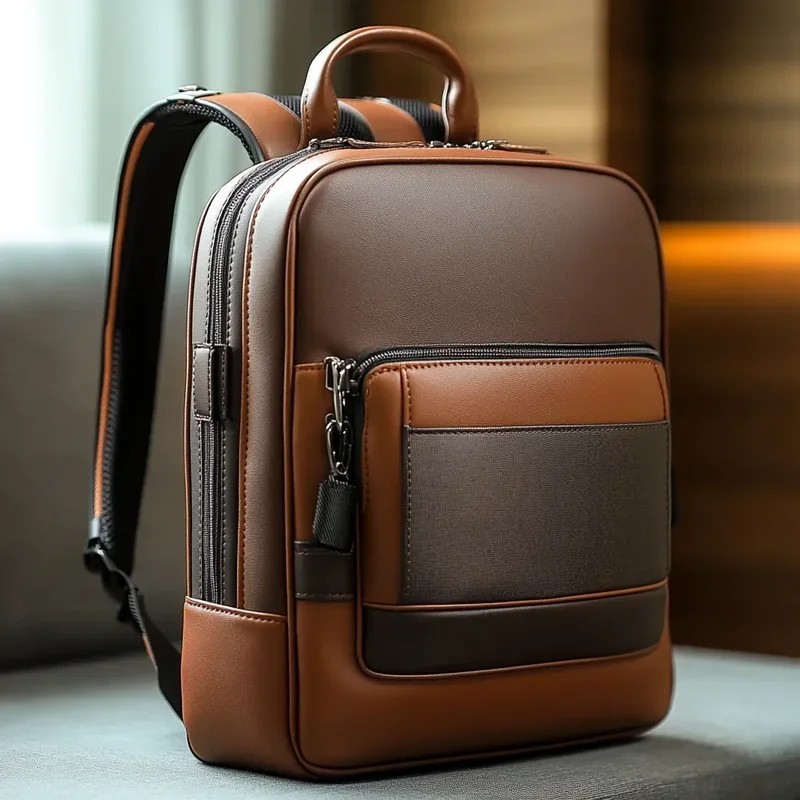
- Tumi pioneered the luxury business backpack with ballistic nylon, leather accents, and meticulous organisation
- Bellroy brought minimalist Australian design to the professional backpack category
- Aer created San Francisco-inspired packs that balanced tech functionality with clean aesthetics
- Peak Design brought camera-grade modularity and design precision to everyday carry
By 2020, a premium backpack in a professional setting was completely unremarkable. The cultural shift was complete — the backpack had moved from military gear to outdoor equipment to fashion accessory to everyday professional essential.
The Cultural Journey in One Generation
Consider this: in 1990, a man in a business suit carrying a backpack would have drawn strange looks. By 2010, it was common in creative industries. By 2020, it was the norm across virtually all professional sectors. The backpack's journey from military equipment to boardroom accessory took less than one human lifetime — making it one of the fastest and most complete wardrobe transitions in modern menswear history.
Key Innovations That Changed Everything
| Innovation | Era | Who | Impact |
|---|---|---|---|
| Wooden external frame | Ancient / 1952 | Ötzi / Dick Kelty | Load transfer from shoulders to frame |
| Internal frame pack | 1967 | Greg Lowe | Body-hugging stability for technical terrain |
| Contoured hip belt | 1970s-80s | Wayne Gregory | 80% load transfer to hips, revolutionised comfort |
| MOLLE/PALS webbing | 1973 | US Military (ALICE) | Modular attachment system still used today |
| Cordura nylon | 1970s | DuPont | Step-change in fabric durability and weight |
| YKK aqua-guard zipper | 1990s | YKK | Waterproof closure without heavy flaps |
| Suspended laptop sleeve | Late 1990s | Tumi / Targus | Protected laptops from impacts and drops |
| Dyneema composite fabric | 2010s | Dyneema Inc. | Strongest fabric per weight, waterproof |
| Laser-cut / bonded construction | 2010s | Various | Eliminated stitch holes, cleaner aesthetics |
| Recycled ocean plastics | 2020s | Various brands | Sustainable performance fabrics |
Where Backpacks Are Heading
The backpack evolution is far from over. Several emerging trends are reshaping what backpacks will look like in the coming decade:
Smart Integration
Built-in USB charging, GPS tracking (Tile/AirTag pockets are already standard in many premium packs), integrated solar panels, and air quality sensors are moving from novelty to expected features. The backpack is becoming a wearable platform, not just a container.
Sustainability as Standard
Brands like Patagonia, Cotopaxi, and Fjallraven are making recycled and bio-based materials standard rather than premium. By 2030, expect most mid-range and premium backpacks to be made substantially from recycled materials, with take-back programmes for end-of-life recycling built into the purchase.
Customisation and Modular Design
Peak Design's cube system and Cotopaxi's modular approach hint at a future where backpacks are platforms — customisable, upgradeable, and adaptable. Rather than buying a new bag for each use case, one modular system might serve as a commute bag, travel bag, and camera bag through component swaps.
Body-Adaptive Ergonomics
3D body scanning and pressure-mapping technology is enabling packs that adapt to individual body shapes. Expect harness systems that automatically adjust strap tension and load distribution based on the wearer's posture and movement patterns.
Hybrid Use Cases
The lines between categories continue to blur. The modern consumer wants one bag that serves as a commute pack on Monday, a travel bag on Friday, and a hiking pack on Saturday. Brands that can engineer backpacks with convertible organisation systems — expandable compartments, removable divider panels, and adaptable strap configurations — will define the next era of backpack design. The backpack's evolution from single-purpose military equipment to multi-role urban platform reflects a broader trend toward versatile, minimalist carry in modern life.
Frequently Asked Questions
Who invented the modern backpack?
Dick Kelty is widely credited with inventing the modern external frame backpack in 1952. Greg Lowe pioneered the internal frame design in 1967, and Wayne Gregory perfected ergonomic harness systems in the 1970s. The backpack evolved through contributions from military, outdoor, and travel industries over centuries rather than from a single inventor.
When did backpacks become fashionable?
Backpacks entered mainstream fashion in the late 1990s and early 2000s. Herschel Supply Co. (founded 2009) helped bridge outdoor aesthetics with urban style. By 2015, premium brands like Tumi, Bellroy, and Aer established backpacks as legitimate professional accessories acceptable in business settings.
Why do military backpacks look different from civilian ones?
Military backpacks prioritise durability and load capacity (20-40kg over rough terrain) using heavy-duty materials like 1000D Cordura and MOLLE webbing. Civilian backpacks prioritise lighter weight, cleaner aesthetics, laptop compartments, and organisational pockets. The visual difference reflects fundamentally different design priorities.
What was the first backpack ever made?
The earliest known backpack-like device dates to approximately 3300 BCE — Ötzi the Iceman carried a hazel wood frame with an animal hide bag. The first modern commercial backpack is attributed to Ole F. Bergans of Norway, who patented a frame design in 1908.
How has technology changed backpack design?
Technology transformed backpacks through new materials (Dyneema, X-Pac), manufacturing methods (laser cutting, bonded seams), smart features (USB ports, GPS tracking), and sustainable production (recycled PET fabrics). Backpacks have evolved from simple carry containers to technology platforms.
What is the difference between a rucksack and a backpack?
They refer to the same category — bags carried on the back. "Rucksack" comes from German (Rücken + Sack) and is more common in British English and military contexts. "Backpack" became the dominant American English term in the mid-20th century. In modern usage, "rucksack" often implies a larger, more rugged bag.
Inspired by Backpack History? Let Us Build the Next Chapter Together.
Whether you are launching a brand that honours heritage craftsmanship or innovating with cutting-edge materials, our manufacturing expertise spans the full spectrum of backpack design and production.
Email Us WhatsApp Chat